by Di Bowerman
Possibly the most important thing the
reader of a biography about an artist wants to see are his or her
paintings.
More precisely, one wants to get a good perception of what their
work is truly like, which is why I was so impressed with Jenny Pery's
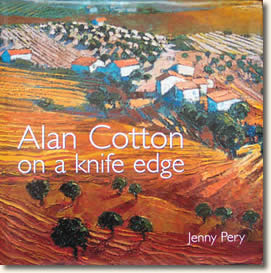
newly-published colourful glossy format book Alan Cotton on a knife
edge, published by Halsgrove at £29.95.
It has the right formula - plenty of background information to give
us an idea of who Alan Cotton is -both as an artist and as a person.
Jenny, herself passionate about art and a keen art historian and
writer, has produced a colourful palette to enjoy.
Born in Redditch we see the support Alan's mother Elsie gave him
to pursue his love of art - even making painting brushes from her
own hair tied on sticks - while his father, mostly out of work, was
resented for making him and brother Bernard go on a nightly ritual
to collect extra beer with money taken from his mother's housekeeping.
"Painting took him out of the monochrome grime of the town
into a landscape where the light sparkled on ears of corn, where
colours were fresh and where he could create his own perfect world."
Being an artist set Alan apart from other students. Indeed we read
he was "caned on the hand in school for drawing in class",
and passing the 11 -plus and going to grammar school certainly made
him an oddity.
But he persevered and went to Redditch School of Art for a while
- one of eight in a class.
One teacher, Norman Neasom, taught Alan his skills and together
they cycled around the countryside exploring subjects and learning
how important it was to draw informatively for painting. Something
Alan continues to do is draw his subject, then paint it. back in
his studio.
His technique of using paint knives rather than brushes was developed
after being encouraged by John Berger, whom he met while living at
St Briavels.
I was amused to read of one suggestion by someone looking at Alan's
thickly applied paint who wondered how long it would take to dry
and what to do with the points of paint left. It was suggested they
should all be cut off!
The book is full of amusing and informative anecdotes that give
a real picture of the artist without feeling you are prying into
his past.
It follows his career and the countries he has visited to find landscapes
to draw and use for his pictures. It also tells of his luck at meeting
David Messum who gave him the chance of exhibiting in London early
on, helping to establish his reputation.
Provence proves to be a favourite destination, and Alan has found
unusual places as subjects, including the ochre quarries of Rustrel
which he painted using the actual ochres dug there.
Tuscany and its wonderful light, Cyprus in June before the landscape
dries up and the reflective beauty of the Venetian canals have all
inspired Alan to put paint to canvas.
The marvellous selection of paintings - from his early St Briavel
landscapes to his latest selection from Morocco - show how the artist
has developed and become more confident in his use of the knife.
The photographs are stunning and taken by John Saunders, who is
mentioned in the dedication.
What the book also shows is Alan the man. His determination to ensure
he puts something back into the community by encouraging local artists
and lecturing and running workshops for them.
He is no ivory-tower painter. He says: "I like ordinary people
and I want my work, to be accessible to ordinary people. I can't
bear pretentious art - I find it embarrassing."
I found this book extremely readable and the illustrations so good
the paint seems wet still on some of them.

"The artist as a man"
Written by Di Bowerman
All rights of the original author
reserved