Book is Informative and generously illustrated
The Cornishman
It is somewhat surprising that Alan Cotton
is not one of Cornwall's leading landscape painters. Although he
numbers the late Terry Frost, Denis Mitchell and John Wells among
his friends, admits that Stanhope Forbes's painting "Village
Philharmonic'' made an impact upon him, and has painted in the county,
regretfully, he has never painted as often or as seriously here as
he has done in his adopted Devon. Devon's gain is definitely Cornwall's
loss for, if any artist ought to be acclaimed as an interpreter of
the Cornish landscape, then it should be Alan Cotton.
His story has been waiting to be told for some time and, happily,
author and art historian Jenny Pery has now done Just that, and done
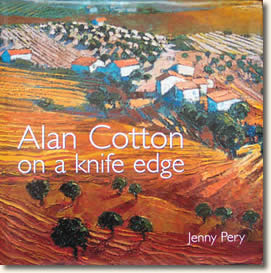
it extremely well, in "Alan Cotton: On a Knife Edge", published
by Halsgrove in association with David Messum Fine Art Ltd at £29.95.
I first met Alan Cotton Just over 20 years ago, as did "influential
art dealer David Messum", when involved in the making of the
BBC-TV film concerning the Newlyn School of Artists "An Artist
on Every Corner". While my meeting with him had no effect whatever
on his future career, David Messum's meeting with him certainly did.
Although Alan Cotton's artistic star was already in the ascendancy
then, with the full support of his wife Pat and their family he had
only recently given up full-time teaching to start full-time painting,
it was his meeting with David Messum which was to open the door of
the art dealer's London gallery, lead to a number of highly successful
solo shows there, and rocket him to fame.
Born in Redditch, Worcestershire, Alan Cotton began painting when
very young - "To keep him occupied when he was small, his mother
made paint brushes for him out of her own hair, tied on to a stick,
and aptly enough, with cotton" - and it was painting which "took
him out of the monochrome grime of the town into a landscape where
the light sparkled on ears of corn, where the colours were fresh,
and where he could create his own perfect world, a pastoral idyll
like that of a Samuel Palmer painting."
He studied at Redditch and Bournville Schools of Art, at Birmingham
College of Art where he spent three years in the Painting School,
and at the University of Birmingham. For a while he then taught and
lectured in the Forest of Dean and it was there, in 1965, that he
made one of his first knife paintings, using a palette knife instead
of a brush, "St Briavel's Common". Shortly afterwards he
experienced his first taste of Devon when "he came south to
Exeter University to do a year's Advanced Diploma in Education".
It was a taste which gave him an appetite for the south-west and
it was not long before he obtained an appointment at Rolle College
in Exmouth, where he was to stay for a dozen years. For a year, in
the 1970s, he was a Research Fellow at the University of Exeter.
However, despite his success in education, the desire to do his own
thing became so pressing that, in 1982, he and his wife Pat gave
up the Jobs they had been doing to start a new life together as a
painter and a business partner.
A bold and brave move: as it happened, it also proved to be a wise
one. Since then, as well as exhibiting often with David Messum, some
16 solo shows altogether, he has exhibited extensively in this country
and abroad, has been the subject of a number of TV films, and is
now represented in public and private collections in the UK and abroad
from the USA to South Africa.
An artist whose stated belief, "You must follow your heart
in painting", has taken him from Ireland to Italy in search
of the muse, equally at home painting in Provence as in Piemonte,
one whose "love of paint and the whole process of painting is
as strong as his love of landscape", his richly textured, seemingly
sculpted, knife-edge paintings are in a class of their own.
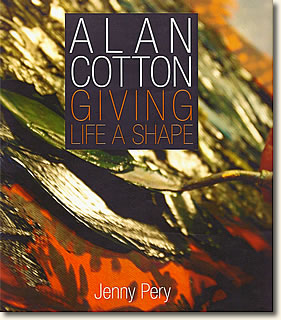
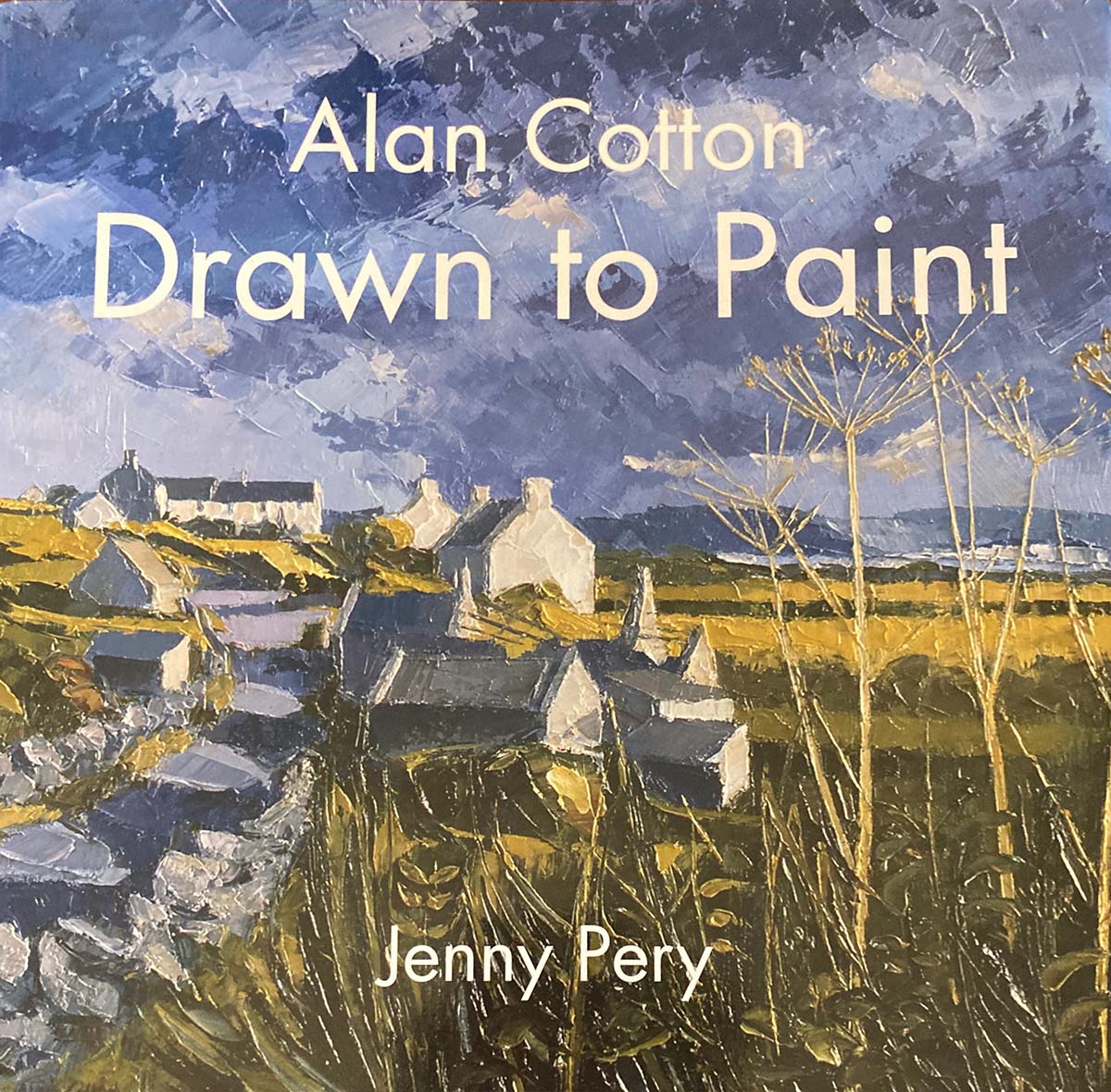
Informative and generously illustrated with more than 100 full colour
plates, readable and as rewarding as it is revealing, Jenny Pery's
look at the life and work of Alan Cotton, an artist who, as she says: "Holds
a position deep at the heart of English landscape painting",
albeit with palette knife rather than brush, is not only a "must
read" but also a "must have" biography

"A 'must read' but also a 'must have' biography"
All rights of the original author
reserved